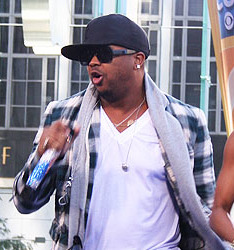
Tricky Stewart and The-Dream wrote "Umbrella" for Britney Spears in January 2007, finishing the first verse in 60 seconds. Jive Records rejected it before it ever reached her. The song that became the longest-running UK number one of the 2000s was turned down by two labels and nearly went to Mary J. Blige before Rihanna heard it and demanded to record it the next day.
Who Actually Wrote "Umbrella"
Christopher "Tricky" Stewart, Terius "The-Dream" Nash, and Kuk Harrell wrote "Umbrella" at Triangle Studios in Atlanta in January 2007. Stewart was experimenting with a hi-hat sound from GarageBand when Nash asked what he was working on. Stewart added chords to the hi-hat, and Nash immediately went to the vocal booth and started singing. Nash wrote the first two verses and chorus over Stewart's skeleton track, completing the first verse in 60 seconds. They finished a demo in a matter of hours.
Jay-Z later added a rap verse and received a co-writing credit. He rewrote his verse without telling Stewart or Nash. Stewart initially didn't understand the change but later realized Jay-Z "made it more about the song, with the metaphors about umbrellas and about the weather" instead of the original version.
The Song Nobody Wanted
Stewart and Nash wrote "Umbrella" specifically for Britney Spears, whom Stewart had worked with on "Me Against the Music" in 2003. They believed Spears, whose personal life was "a little out of control" at the time, needed a hit for her comeback. She was working on her fifth album, Blackout, so they sent the demo to her management. Jive Records rejected it, claiming they already had enough songs for the album. Spears never heard the track.
After the rejection, Stewart and Nash shopped the song to other labels. British singer-songwriter Taio Cruz received it but failed to convince his label, Mercury Records, to release it. During the 2007 Grammy season, Stewart played the demo for an associate of Mary J. Blige and promised her the song. Karen Kwak and A&R Angel Maldonado from Island Def Jam began calling Stewart and his manager incessantly to secure it for Rihanna, who was working on Good Girl Gone Bad. Blige never heard the full song due to her Grammy obligations and "had to sign off on the record before her reps could accept it."
Island Def Jam chairman Antonio "L.A." Reid, a friend of Stewart who had established his first studio, stepped in. Reid admits he "made the producers an offer they couldn't refuse." Mark Stewart, Tricky's manager, explained the decision: "We knew Rihanna's album would be out in a few months. Mary wasn't even in an album cycle yet. We made the sensible business decision."
How the Song Came Together
By early February 2007, the demo reached Reid's A&R executive Karen Kwak, who passed it to Reid with confirmation they'd found a song for Rihanna. Reid immediately sent it to Rihanna, who responded: "When the demo first started playing, I was like, This is interesting, this is weird. But the song kept getting better. I listened to it over and over. I said, 'I need this record. I want to record it tomorrow.'"
Rihanna recorded "Umbrella" at Westlake Recording Studios in Los Angeles with vocal production by Kuk Harrell. Stewart admitted he was initially reluctant about whether Rihanna was the right artist for the track. After recording the "ella, ella" catch phrase, he felt they were onto "something."
The song's musicscape is based on the hi-hat, synthesizers, and a distorted bassline. According to Entertainment Weekly, the beat can be recreated through a drum loop from GarageBand's Vintage Funk Kit 03. The sheet music shows the key of B♭ minor with a tempo of 87 beats per minute. The song opens with Jay-Z's rap verse, followed by traditional verse-chorus form with the "ella, ella" hook following every chorus.
If you're building pop or hip-hop tracks and need lyrics that flow naturally over production, a free AI lyrics generator can help you test ideas quickly before committing to full demos.
Chart Performance and Awards
"Umbrella" was released worldwide on March 29, 2007. It topped the charts in 19 countries including Australia, Canada, Germany, Spain, Ireland, Sweden, Switzerland, the United Kingdom, and the United States.
In the United States, the song debuted at number 91 on the Billboard Hot 100 on April 28, 2007. It reached number one on June 9, 2007, and stayed there for seven consecutive weeks. The single achieved the biggest debut in iTunes' six-year history in the United States, breaking a record previously held by "Hips Don't Lie." It debuted atop the Hot Digital Songs chart with first-week sales of over 277,000 units, the highest digital debut since Nielsen SoundScan began tracking downloads in 2003, surpassing Justin Timberlake's "SexyBack" record of 250,000 sales. "Umbrella" became the second best-performing single of 2007 on the Hot 100, behind Beyoncé's "Irreplaceable." It also became the first song to top the Canadian Hot 100 when that chart launched.
In the United Kingdom, "Umbrella" entered at number one based on digital sales alone, becoming Rihanna's first UK chart-topper and Jay-Z's third. It remained at number one for ten consecutive weeks, breaking Gnarls Barkley's "Crazy" record for longest chart-topper of the decade. The song's chart performance coincided with prolonged rain and flooding in the UK, where it became one of the most played songs on radio in the 2000s. By the end of 2008, it had sold over 600,000 copies in the UK. Rihanna became the seventh artist in history to top the UK chart for ten consecutive weeks.
In Australia, "Umbrella" entered at number one on June 10, 2007, and spent six consecutive weeks at the top. It earned a 5× Platinum certification, denoting sales of 350,000 copies, and ended the year as the country's third best-selling single of 2007. In New Zealand, it reached number one and stayed there for six consecutive weeks, becoming the country's best-selling single of 2007 with a Platinum certification for 15,000 copies sold.
The music video, directed by Chris Applebaum and featuring Rihanna's nude body covered in silver paint, won Video of the Year at the 2007 MTV Video Music Awards. Entertainment Weekly ranked the song number one on their 10 Best Singles of 2007. Rolling Stone and Time listed it at number three on their 100 Best Songs of 2007. In 2021, Rolling Stone ranked "Umbrella" number 332 on their revised list of the 500 Greatest Songs of All Time.
Artists who covered "Umbrella" include All Time Low, the Baseballs, Train, Manic Street Preachers, McFly, Mike Shinoda of Linkin Park, OneRepublic, Taylor Swift, and Vanilla Sky. In February 2023, the song re-entered the US Billboard Hot 100 at number 37 following Rihanna's performance at the Super Bowl LVII halftime show.
Why "Umbrella" Still Works
The hook is the entire song. The "ella, ella" catch phrase transforms an ungainly three-syllable word into eleven hypnotic syllables that lock into the hi-hat pattern. Jonah Weiner of Blender noted Rihanna "disassembles its ungainly title into 11 hypnotic, tongue-flicking syllables." That rhythmic breakdown is the reason people remember this song sixteen years later.
The lyric uses a single extended metaphor without overexplaining it. "You can stand under my" is devotion stripped to its simplest image. The umbrella represents protection, loyalty, and partnership without spelling out every emotional detail. The metaphor works because it's visual, universal, and doesn't require translation.
The structure creates anticipation. Opening with Jay-Z's rap verse before Rihanna enters is unconventional for a pop single. It delays gratification and makes Rihanna's entrance feel earned. The song builds through verse and pre-chorus, then releases tension in the chorus with that massive "ella, ella" hook. The fadeout ending leaves listeners wanting more instead of overstaying its welcome.
Andy Kellman of AllMusic noted Rihanna's vocals are "somehow totally convincing without sounding all that impassioned—an ideal spot between trying too hard and boredom." That restraint is the secret. Rihanna doesn't oversell the emotion. She delivers the lyric with confidence, not desperation, which makes the promise of protection feel genuine rather than performative.
What Songwriters Can Steal From "Umbrella"
- Break down your title word rhythmically. Stewart and Nash didn't just use "umbrella" as a word—they turned it into a percussive element. If your title has multiple syllables, experiment with how you can stretch, chop, or repeat it to create a rhythmic hook independent of melody. The "ella, ella" repetition works because it locks into the hi-hat pattern and becomes part of the production, not just the lyric.
- Use one visual metaphor and commit to it. "Umbrella" doesn't mix metaphors or explain itself. The entire song is about standing under an umbrella as protection. That singular focus makes the song memorable and quotable. Pick one concrete image that represents your song's emotional core, then build every line around it without wandering into unrelated territory.
- Write the first verse fast, then refine everything else. Nash wrote the first verse in 60 seconds because he trusted his instinct. That initial burst captured the song's energy and core idea. The rest of the writing process involved building around that foundation. When you have a strong opening idea, get it down immediately. You can edit and perfect the bridge, second verse, and details later, but the first verse should feel urgent and instinctive.
Frequently Asked Questions
Did Britney Spears ever hear "Umbrella"?
No. Jive Records rejected the song before it reached Britney Spears. Stewart and Nash wrote it specifically for her 2007 album Blackout, but her label claimed they already had enough material. Spears never heard the demo.
How long did it take to write "Umbrella"?
The-Dream and Tricky Stewart wrote the first verse in 60 seconds and completed a full demo in a matter of hours at Triangle Studios in Atlanta in January 2007. The rapid writing process happened after Stewart found a hi-hat sound in GarageBand that inspired Nash to start singing immediately.
Why did "Umbrella" stay at number one for so long in the UK?
The song's ten-week run at number one in the UK coincided with prolonged rain and flooding in the country during summer 2007. The timing made the umbrella metaphor culturally relevant, and the song became one of the most played tracks on UK radio in the 2000s. It broke the record for longest-running number one of the decade.
Try building your own hooks and metaphors at mysoniq.com/app.
Related reading
- Free Songwriting AI Online: Write a Full Song in One Click
- The 10 Best Prince Songs, Ranked by Songwriting Craft
- 11 AI Songwriting Assistants That Help You Finish Songs
Sources
Background, chart and award facts: "Umbrella (song)" on Wikipedia (CC BY-SA 4.0). Analysis and Hit Craft notes are SONIQ's own.
Photo: Jeremy Chan from United States, CC BY-SA 2.0, via Wikimedia Commons