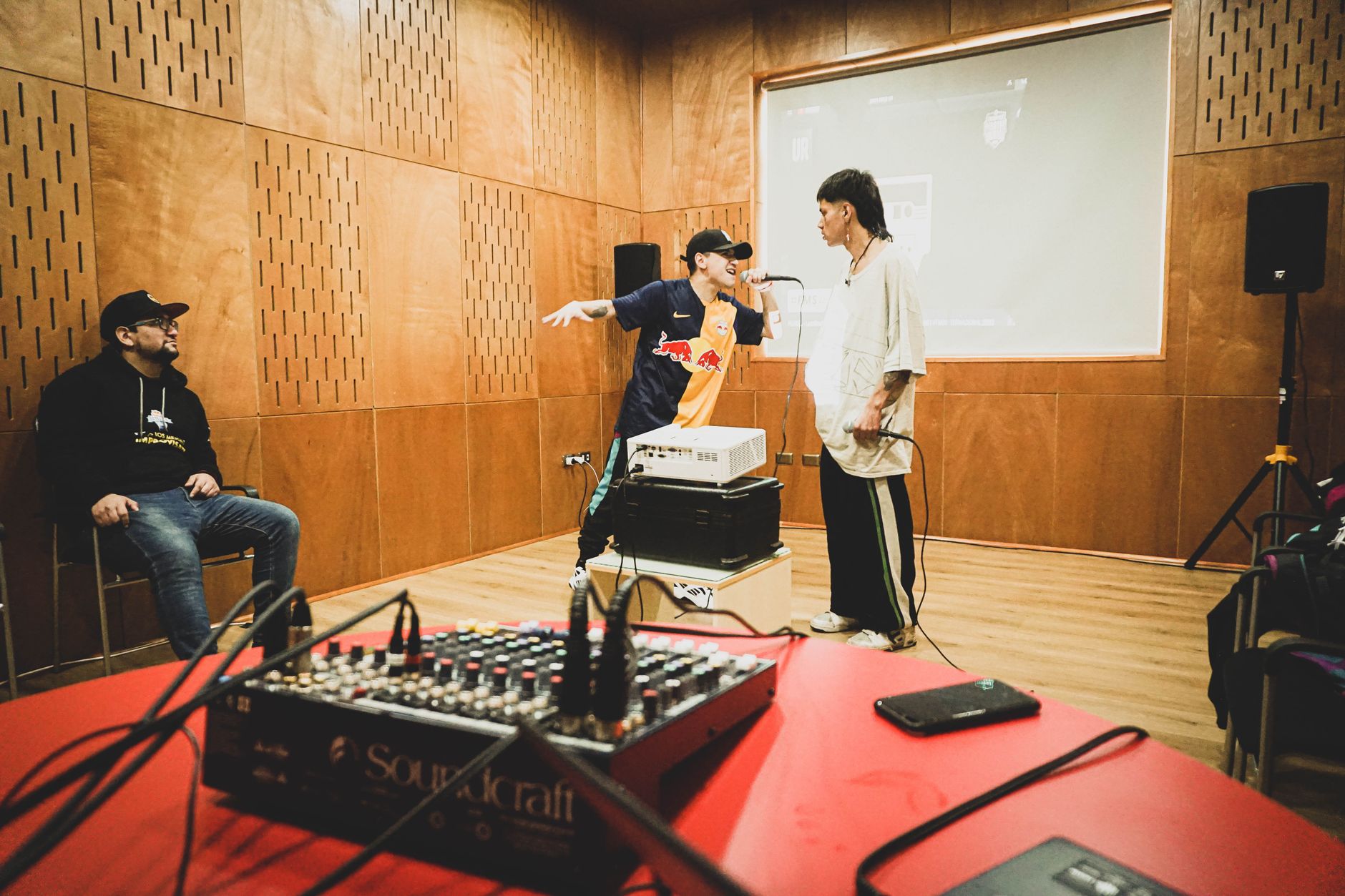
Freestyling isn't about waiting for inspiration to strike. It's a trainable skill built on vocabulary recall, rhythmic pattern recognition, and reducing the mental friction between thought and delivery. Most beginners freeze because they're trying to be clever and maintain rhythm simultaneously—two competing cognitive loads.
The drills below isolate each component, then combine them. Use a free rap lyrics generator to build your vocabulary bank, then apply these exercises to internalize patterns until they become automatic.
Why Most Beginner Freestylers Fail
Three bottlenecks kill beginner freestyles:
- Limited active vocabulary: You know thousands of words passively, but only access 200-300 when rapping under pressure
- No fallback patterns: When you blank, you have no pre-built phrase structures to buy time
- Rhythm breaks focus: Maintaining tempo while searching for rhymes splits attention and crashes both tasks
Professional freestylers aren't making everything up in real-time. They're recombining memorized patterns, phrases, and rhyme schemes they've drilled thousands of times. The goal is to automate the technical layer so your brain can focus on content and wordplay.
Drill 1: Single-Word Association Chains
Set a 60-second timer. Pick a random object in your room. Rapid-fire say related words without stopping:
"Lamp—light—bright—night—fight—flight—height—kite—bite—white—right—sight..."
No rhythm, no rhyme scheme—just continuous association. This builds the neural pathway between seeing a concept and accessing related vocabulary instantly. Do this daily with different starting words. Your freeze time during actual freestyles will drop significantly within two weeks.
Drill 2: Metronome Rhyme Runs
Set a metronome to 80 BPM. Pick a simple word like "day." Rap one rhyme per beat for 16 beats:
"Day, play, say, way, bay, ray, stay, may, pay, lay, gray, hay, stray, clay, spray, pray"
This separates rhythm maintenance from content creation. You're training your internal clock while expanding your active rhyme vocabulary. When this becomes easy, increase to 90 BPM, then 100. The tempo pressure forces faster recall.
Drill 3: Object Description Freestyle
Point at an object. Describe it for 30 seconds in rhythm over a simple beat. Don't worry about rhyming—just maintain tempo while describing color, function, texture, location, and history.
"Looking at this coffee mug sitting on my desk / ceramic white with a chip up on the edge / I bought it three years back at the corner store / now I use it every morning can't ignore..."
This drill teaches you to generate content continuously without the added pressure of rhyme schemes. Once you can describe any object for 60 seconds without stopping, add rhymes.
Drill 4: Pre-Built Phrase Banking
Memorize 10 flexible connector phrases that fit most contexts:
- "Let me tell you something that you need to know"
- "I've been working on my craft every single day"
- "Looking at the situation from a different view"
- "Never gonna stop until I reach the top"
- "Started from the bottom now I'm on the rise"
These aren't crutches—they're recovery tools. When you blank mid-freestyle, drop one of these to maintain momentum while your brain searches for the next original thought. Check out what to say in a freestyle rap when your mind goes blank for more emergency phrases.
Drill 5: Opposite Word Flips
Rap a line, then immediately flip it to the opposite meaning:
"I'm moving fast, never gonna slow down"
"I'm taking time, never gonna speed up"
"Money in my pocket, living real good"
"Broke and I'm struggling, times are real tough"
This builds flexibility in your thought patterns and prevents you from getting locked into one narrative direction. It also creates natural contrast, which makes freestyles more interesting to listeners.
Drill 6: Vowel Sound Anchoring
Pick a vowel sound (AY, EE, I, OH, OO). Freestyle for 30 seconds using only words with that vowel sound as the primary rhyme:
"I see the trees and feel the breeze, it's easy when you seize these keys, believe in me, I'm free, no fees, just me and beats, complete, elite..."
This drill expands your rhyme vocabulary beyond perfect rhymes and teaches assonance—the technique that makes multisyllabic rhymes sound cohesive even when they're not perfect matches.
Drill 7: Topic Switching Every 4 Bars
Freestyle over a beat, but switch topics every four bars. Go from weather to food to childhood to current location:
Bars 1-4: Rain outside
Bars 5-8: Pizza toppings
Bars 9-12: Elementary school
Bars 13-16: Your bedroom
This prevents the monotony that kills most beginner freestyles and trains rapid context switching. If you run out of topics, browse 100 rap topics to write about and memorize 20 as mental bookmarks.
Drill 8: Question and Answer Bars
Structure your freestyle as questions in odd bars, answers in even bars:
"Why do I rap every single day? (question)
Because the music takes my stress away (answer)
What do I want from this whole career? (question)
To make my voice heard far and near (answer)"
This creates built-in structure that guides your content and maintains listener engagement. The question-answer format also mirrors conversational flow, making your delivery sound more natural.
Drill 9: Speed Variation Control
Freestyle one verse at half-time (slow, deliberate), then double-time (rapid-fire) over the same beat. This teaches you to control rap flow independently of the beat's tempo.
Most beginners lock into one speed and sound robotic. Being able to shift gears mid-freestyle—slowing down for emphasis, speeding up for energy—separates competent freestylers from memorable ones.
Drill 10: Daily 5-Minute Sessions
Set a timer for five minutes. Freestyle continuously without stopping, even if you're saying nonsense. The rule: your voice never stops.
This builds endurance and removes the fear of imperfection. Most beginners stop when they say something awkward. This drill teaches you to push through awkward moments until you find your rhythm again. Record these sessions and review weekly—you'll hear measurable improvement in flow, vocabulary access, and recovery speed.
Combining Drills Into Practice Sessions
Don't do all ten drills daily. Rotate through this weekly structure:
Monday/Thursday: Drills 1, 2, 10 (vocabulary and rhythm foundation)
Tuesday/Friday: Drills 3, 7, 9 (content generation and variation)
Wednesday/Saturday: Drills 4, 5, 6, 8 (structure and recovery tools)
Sunday: Full 15-minute freestyle session applying everything, no specific drill focus
Track your progress by recording Sunday sessions. Listen for: moments where you freeze, vocabulary repetition, rhythm breaks, and recovery time when you blank. Each week, one of these should improve.
Frequently Asked Questions
How long does it take to get good at freestyling?
With daily 15-minute practice using these drills, most beginners can maintain a 60-second freestyle without major freezes within 4-6 weeks. Sounding polished and clever takes 6-12 months of consistent practice. The skill compounds—month three to six shows the fastest improvement.
Should I memorize written verses to help my freestyles?
Yes, but use them correctly. Memorize 20-30 written bars, then practice inserting them naturally into freestyles as anchors. The goal isn't to recite memorized material—it's to have reliable segments you can drop into while improvising around them. This hybrid approach is what most "freestylers" actually do.
What if I can't think of anything to say while freestyling?
Describe what you see, hear, or feel in that exact moment. The room, the beat, your breathing, your clothes. Physical observation is the fastest content source when your mind blanks. It's also authentic, which listeners respond to better than generic bragging. Drill 3 specifically trains this skill.
Start with one drill today, record yourself, and compare against a recording one week from now. Try SONIQ to generate practice bars and build your vocabulary bank faster.
Related reading
- How to Write a Song: Step-by-Step Guide for Beginners
- 11 Earworm Songwriting Techniques That Stick
- 22 Songwriting Techniques That Make Hits (With Examples)
Photo by Jonathan Mendoza on Pexels